
by Dr. Jochen Bauer*
This was the second large order that BVG has received from the Papier- und Kartonfabrik Varel. The business relation-ship started in 2004 with the supply of the enzymatic degradation plant and the work stations for the film press on the PM 5.
At that time the continuous enzymatic starch degradation was new ground for PK Varel, because the only experience had been with thermochemical degradation for the size press on the old PM 4. The newly introduced technology of catalytic hydrolysis with alpha amylase quickly con-vinced the paper makers at Varel, how-ever.
It was possible to demonstrate that, with the BVG technology, starch use could be optimised compared to the previously practised thermochemical method. There were also other benefits: the “mirror” on the film press rolls was more uniform and there was less contamina-tion of the film press. The maintenance costs were considerably lower because no excess oxygen was released that greatly corrodes the frames, pumps etc. and leads to rust formation. Another substantial benefit is that hazardous materials are no longer used for the thermochemical starch treatment.
All of these advantages were very wel-come to PK Varel and contributed to the development of a trusting business rela-tionship. This gave BVG a good chance from the start of getting involved in supp-lying goods for the PM 4 project.
PK Varel commissioned BVG in Greifenberg with supplying the starch and auxiliary agent systems for the PM 4 project.
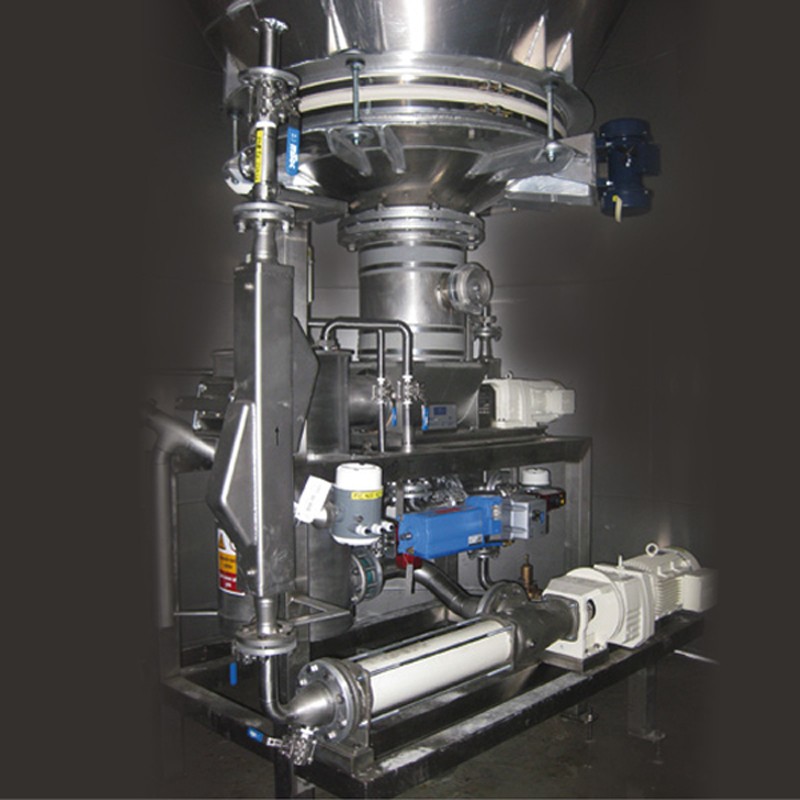
The enzymatic starch degradation plant
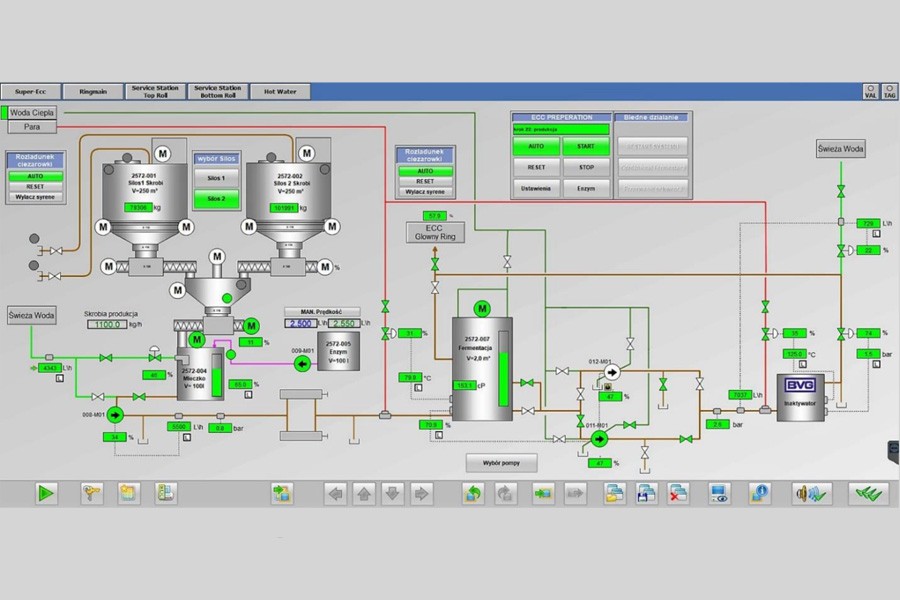
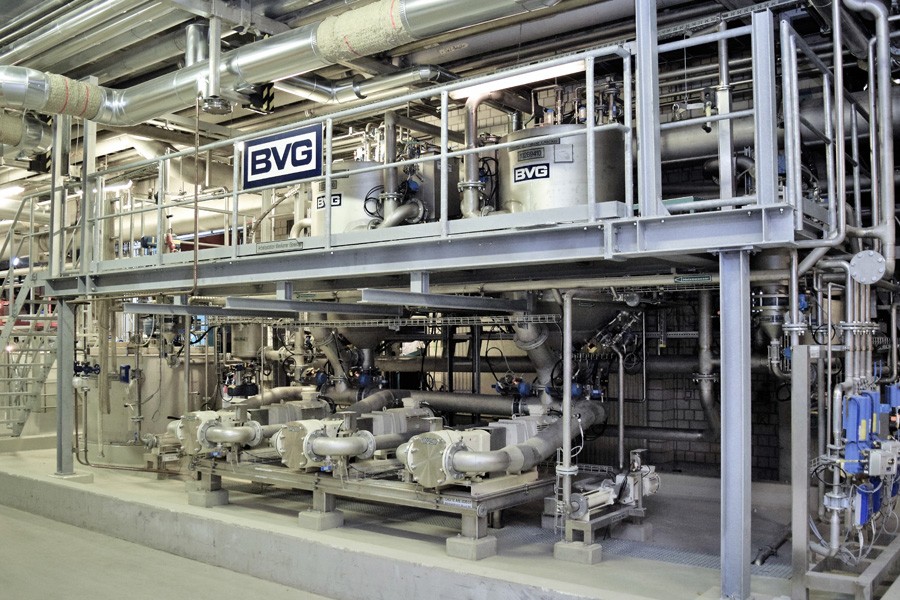
The realisation of the chemical handling for the PM 4 project took place in two phases. Firstly a BVG Super-ECC enzymatic starch degradation plant was installed at the PM 4 to supply the new film press. This replaced the existing thermochemi-cal plant.
The construction of such plants has a long tradition at BVG. More than 130 of them are operating throughout the world, something that cannot be matched by any other supplier. The technology is continu-ously being improved. A new achievement is the “high turbulence starch degrada-tion”- a process that further improves the quality of the manufactured starch paste.
A European patent has been granted for this process. The most recent improvement is the “wastewater-free” starch preparation “Nopoll”. Here the wastewater containing starch that occurs during the starting and stopping of the plant is recycled. BVG has applied for patent protection for this idea.
Although this option has not been real-ised at Varel, it can be retrofitted at little expense at a later date.In addition to the treatment of degraded starch, a spray starch strand was installed to supply the board mill. The spray starch is manufactured from native starch from the same silo and the same slurry station used to manufacture the surface starch.
This plant concept has con-siderably simplified handling of the spray starch and reduced costs. The contract for the new starch treat-ment plant is compiled as follows:
- two starch silos for powdered goods each with a volume of 200 m3,
- continuous slurry production under each silo with a special control of slurry con-centration,
- slurry storage tank with two dosing lines,
- one line for spray starch with adjustable online dilution,
- one line to supply the enzymatic starch degradation plant,
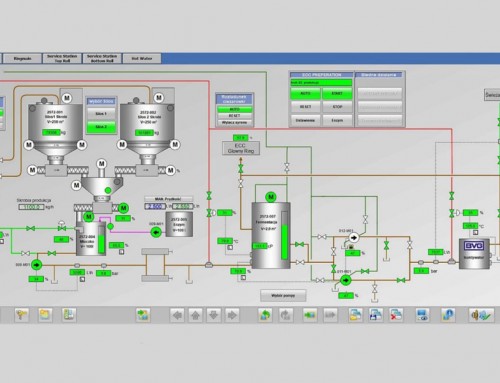
- a BVG-Super-ECC enzymatic starch degra-dation plant with online viscosity meas-urement in the degradation converter,
- a storage tank for the concentrated starch paste,
- closed circular pipeline to the work stations,
- work stations to supply the speed sizer, dilution stations for the size,
- working tanks,
- centrifugal pumps,
- machine circuits,
- hot water preparation.
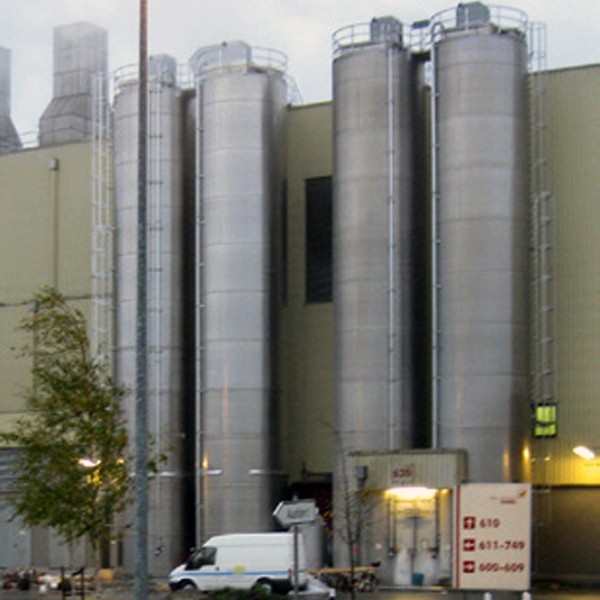
This delivery largely corresponded to the equipment that was installed for the PM 5 in 2004. PK Varel now has four starch silos with four BVG slurry stations. BVG designed the work stations in line with customer wishes, and was able to incorporate the experiences gained from the PM 5.
The fact that the new PM 4 has been equipped with almost identical starch equipment as the PM 5 shows that PK Varel is still satisfied with the BVG technology.
High temperatures during application on the film press
A new element in this context was the requirement to heat the starch applied to the film press to 90 °C. This is the highest temperature that BVG is aware of for oper-ating the film press. The advantages of this method are clear: the degree of degradation of the starch can be kept to a lower level with the same viscosity compared to a starch bath at 70 – 80 °C. This increases the dura-bility of the paper – or reduces the starch requirement.
Further chemical handling
In the second step the chemical handling for the new deinking plant (line 3 with 460 tpd) was awarded to BVG. These sys-tems were put into operation in the sum-mer of 2012.
The following chemicals are involved:
- Hydrogen peroxide oxidising bleach,
- Sodium hydroxide to set the pH value,
- Water glass complexing agent,
- Soap to separate the printing inks from the fibre,
- Hydrosulphite reducing bleaching agent.
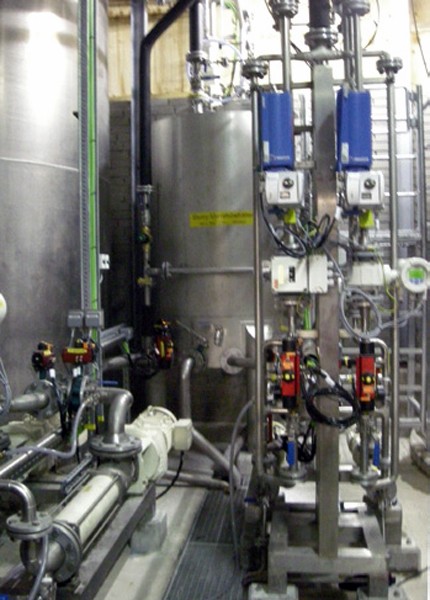
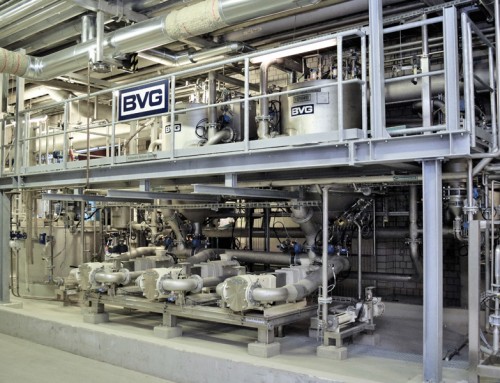
Here too novel details were realised at the request of the customer, e. g. the indi-vidual parts of the plant were built as special racks with collecting trays beneath each of them. As a result no complex floor containers with expensive special coating are required which have to be implemented according to the Federal Water Act (WHG) and which are subject to acceptance by the TÜV. This saves time and money.
Hydrogen peroxide, sodium hydrox-ide and water glass are delivered in liq-uid form by a tank truck and conveyed to appropriate storage tanks. There was no need for a collecting tray for the trucks as connecting hoses have double walls (PK Varel standard), have leak detection and correspond to the WHG. This also saves a great deal of money.
Soap is delivered in big bags. There was no in-situ saponification of fatty acids with sodium hydroxide (a BVG spe-ciality) because the soap requirement at approx. 3.5 t/d is relatively low. A conven-tional batch plant with heating tank was installed. The soap is dissolved at approx. 70 °C and then stored in a storage tank, from where it is metered into the pulper on line three. Hydrosulphite is supplied in special tanks and dissolved in a con-tinuous system. The dissolved product is conveyed directly to the metering points (bio-water and slurry pump line three) because hydrosulphite is not stable in dis-solved form.
The system can accommodate two special tanks simultaneously which are then emptied in succession. 1 t and 2 t tanks can be deployed. 8 t per day are required. The system was built according to the specific safety requirements for hydrosulphite, and special attention was paid to heat development and fire safety. BVG has already built ten hydrosulphite systems and has been able to gain exten-sive ex perience in this field, leading to constant further development of the sys-tem technology.
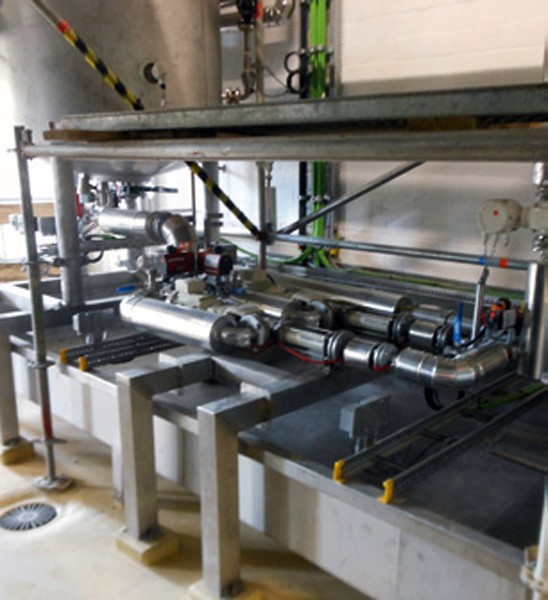
Special attention was paid to heat development and fire safety.
State of the art systems
The systems were designed to satisfy the highest quality standards and to repre-sent “state of the art” technology. That is the only chance BVG has in a high wage country like Germany of survival in the global market. This company philosophy has proven to be effective and is acknowl-edged by customers.
In paper mills, the chemicals systems form part of the ancillary systems that need to work. No saleable paper can be produced if these systems fail, so that failure constitutes an unacceptable risk. At Varel the above requirements were implemented consistently; consequently there were no complaints when the TÜV conducted the acceptance of the systems, and the operating licence was granted immediately.
BVG wishes PK Varel luck and success with operation of the new PM 4 as well as fulfil-ment of the expectations associated with the project. BVG thanks PK Varel for the contract, for the trust the company placed in them again, and for the excellent team-work during the entire project phase.
*Dr. Jochen Bauer, CEO and owner of Bauer Verfahrenstechnik GmbH